Indoor signs
1/16/2026
Customers form impressions quickly; often within seconds of arriving at a location. Before they interact with staff, products, or services, they interact with the space itself. If that space feels confusing or difficult to navigate, the experience begins with uncertainty. Good wayfinding signage eliminates that uncertainty, replacing frustration with confidence and clarity.
Wayfinding signage is not just about pointing people in the right direction. It is a strategic system that guides visitors intuitively through an environment, reinforcing brand credibility, improving accessibility, and supporting operational efficiency. In retail, healthcare, corporate campuses, educational institutions, airports, and event venues, effective wayfinding is a cornerstone of a positive customer experience.
When visitors can easily understand where they are and where they need to go, they feel more in control. That sense of control directly impacts satisfaction, dwell time, and trust in the organization managing the space. Conversely, poor navigation increases stress, creates delays, and leaves lasting negative impressions.
Wayfinding signage supports customer experience by:
These benefits are especially important in large or complex spaces where visitors may already feel anxious, rushed, or overwhelmed.
High-performing wayfinding programs rely on a layered approach that supports visitors from arrival to destination.
Outdoor wayfinding signage establishes first orientation. Parking indicators, site maps, entry signage, and building directories help visitors understand where they are before they step inside.
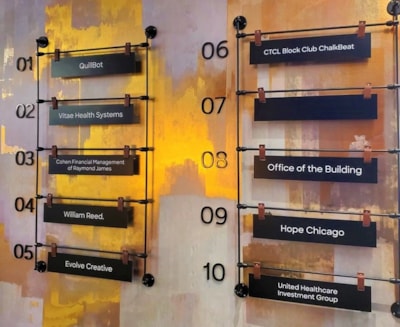
Interior wayfinding signage takes over once inside, guiding visitors through corridors, stairwells, elevators, and departments. Directional arrows, floor directories, and confirmation signage reassure visitors that they are on the right path.
Digital wayfinding signage enhances flexibility and responsiveness. Interactive directories, kiosks, and digital displays allow organizations to update information instantly, provide multilingual support, and offer mobile navigation handoffs.
When these layers work together, navigation feels natural rather than forced.
Consistency is one of the most overlooked aspects of wayfinding design. When naming conventions, typography, colors, and symbols remain uniform throughout a space, visitors learn the system quickly. If a department is labeled one way on a directory and another way on a door sign, confusion follows.
ADA-compliant wayfinding signage is not only a legal requirement; it is a fundamental part of inclusive design. Tactile lettering, braille, high-contrast colors, and proper mounting heights ensure accessibility for individuals with visual impairments, while also improving clarity for all users.
Incorporating ADA standards from the beginning prevents costly retrofits and demonstrates a commitment to equity and user-centered design.
Even the most beautifully designed sign fails if it is placed incorrectly. Effective wayfinding signage appears precisely where decisions are made. Signs placed too early or too late force visitors to stop, turn around, or second-guess their route.
Strategic placement supports natural movement and reinforces intuitive flow.
Facilities that change frequently benefit from digital wayfinding signage. Hospitals, corporate campuses, universities, and event venues often experience room changes, tenant moves, or temporary closures. Digital systems allow instant updates without reprinting or reinstalling signage.
Interactive kiosks also reduce reliance on staff for basic directions, freeing teams to focus on higher-value interactions.
Every sign communicates something about your organization. Clean, well-designed wayfinding signage signals professionalism, preparation, and respect for the visitor’s time. Inconsistent or outdated signage sends the opposite message.
When navigation feels effortless, customers associate that ease with your brand.
Image360 approaches wayfinding as a strategic, end-to-end solution. Our process includes site audits, spatial analysis, design, fabrication, installation, and ongoing support. We align interior, exterior, and digital signage into a cohesive system that improves customer experience from day one.
From ADA-compliant room identification to complex digital wayfinding solutions, Image360 helps organizations turn complex environments into intuitive, welcoming spaces.